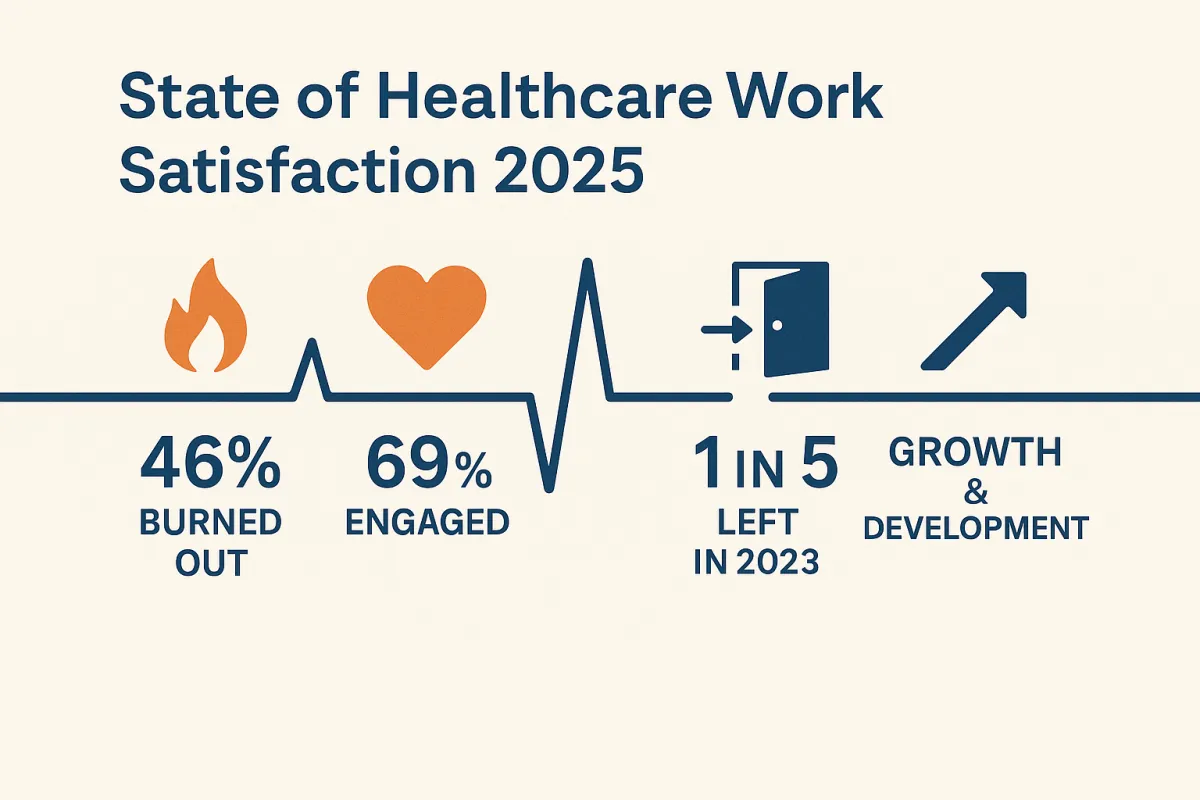
State of Healthcare: Work Satisfaction 2025
State of Healthcare: Work Satisfaction 2025
The healthcare workforce has been through a lot in the last few years. Burnout, turnover, and staffing shortages are everywhere. But there are also signs of hope and progress. Here’s what the data is telling us about the current state of work satisfaction in U.S. healthcare, and what leaders can do about it.
Engagement Is (Finally) Climbing Back
After years of pandemic fatigue, employee engagement scores in healthcare ticked up in 2023 for the first time since COVID hit. About 69% of healthcare workers are now categorized as engaged or highly engaged (Press Ganey, 2024).
👉 But one in three employees is still not engaged. That’s a lot of untapped energy and potential walking around your hospital or practice.
My take: Engagement isn’t about pizza parties. It’s about feeling respected, heard, and supported. If you want morale up, start with trust and communication.
Burnout Is Still a Crisis
Nearly half of healthcare workers report feeling burned out (ADP Research Institute, 2023). Nurses and mid-level managers are hit especially hard. And it’s not just stress; burnout is now one of the top reasons people leave the field entirely (NAMI, 2023).
👉 Nearly 800,000 nurses under age 40 have said they plan to leave by 2027 (NSI Nursing Solutions, 2023).
My take: This is the red flag for every leader. Burnout doesn’t just “happen," it’s the predictable outcome of overload, lack of control, and no recovery time. Leaders can’t yoga their way out of this one. Fixing staffing models, creating safe places for mental health conversations, and giving people real flexibility are the levers that matter.
Retention Is Fragile
Turnover is still sky-high: 1 in 5 healthcare employees left their job in 2023, and for newer hires it was closer to 1 in 4 (Press Ganey, 2024). Nurses are especially at risk, with annual turnover rates near 19% for RNs (NSI Nursing Solutions, 2023).
My take: Pay matters, but relationships matter more. Employees with strong, positive relationships with their leaders are far less likely to leave (Press Ganey, 2024). That’s the part leaders can influence right now.
Communication Makes or Breaks Trust
Only about 29% of employees are very satisfied with the communication they get from leadership (Gallagher, 2024). And poor communication is one of the top reasons people quit: 61% of employees considering leaving cite communication as a factor (Gallagher, 2024).
My take: If your team doesn’t know where the organization is headed, or why decisions are being made, they’ll make up their own stories. And those stories are rarely generous. Clarity beats silence every time.
Growth and Development = Staying Power
Career development is showing up as a major driver of satisfaction. When people see a path forward through coaching, mentorship, training, or career ladders, they’re far more likely to stay engaged and stay put (Journal of Health Policy, Organization and Research, 2025).
My take: Healthcare has a leadership gap, not just a staffing gap. If you want people to stay, invest in their growth. Even small steps like internal mentorship for new hires can change retention numbers dramatically (AHA, 2024).
Leaders Need Support Too
Here’s the kicker: leaders themselves are less engaged than before the pandemic, down about 3.7% since 2020 (Press Ganey, 2024). That’s a problem, because disengaged leaders can’t build engaged teams.
My take: Leadership is lonely if you don’t have support. Coaching, development, and peer groups aren’t “extras” anymore. They’re how we build leaders who can survive, and thrive, in this climate.
Bottom Line
The state of healthcare work satisfaction in 2025 is mixed: progress on engagement, but persistent burnout and turnover. What’s clear is this: leaders have outsized influence on whether their teams stay, grow, and thrive.
If leadership feels heavy right now, it doesn’t have to be carried alone. That’s exactly why we built the Employee Development Lab, to equip leaders with the tools, community, and confidence to lead without losing their minds.


